
Public Buildings of Note
Year |
Building of Note |
Picture |
| 13th century |
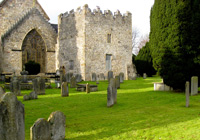
Old St. Mary's Church. None of the original church remains visible today. During the 1300's to the 1500's, many changes were made, although specific details are not available. The east and west windows date from c. 1500. A stained glass window, by Harry Clarke Studios, was installed in 1946, in appreciation of the Tinsley family. |
|
| 13th century |
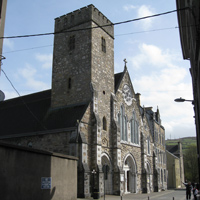
Franciscan Friary. It was originally a long and narrow building, and extended across what is now Abbey Street. The entrance was via Bank Lane. Around 1543, tha abbey was dissolved and the building and land sold to the duke of Ormonde and the Sovereign and commonalty of Clonmel. In Cromwellian times, a fort was built on the property.Much of the nave was destroyed in 1760, when Abbey Street was built. The current building was built between 1884-1886, and the friary house added in 1892. |
|
| 1675 |
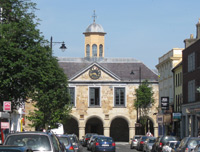
Main Guard. A courthouse during the Palatinate of Tipperary. Built by the Duke of Ormonde. The building was also used as a "Tholsel", or tax collection booth. At the start of the 19th century, it ceased to be a courthouse, and was used by soldiers as a guardhouse. It became known as the "Main Guard". |
|
| 1690 | Sir Thomas' Bridge. Built by Sir Thomas Osborne, who had lands on both banks of the river. He lived at NewtownAnner. | 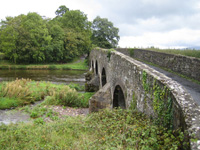
|
| 1800 |
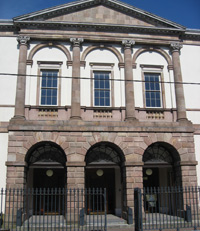
Courthouse The courthouse was completed in 1800, and replaced the Main Guard as the town court. |
|
| 1801 |
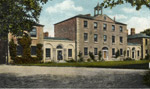
Military Barracks.Officers Mess built 1830. Named Victoria Barracks. Many soldiers stationed here were accompanied by their wives, as can be readily seen by the headstones in Old St. Mary's graveyard. There were up to 500 soldiers and their wives, plus their horses, all contributing to the local economy. There were two barracks in the grounds, an artillery and an infantry barracks. |
|
| 1810 | Swiss Cottage | |
| 1792 |
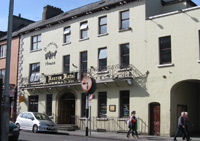
Hearns Hotel The entrance archway has the year 1792 inscribed, and may be taken as the date of its construction. Bianconi established his coaching/car service, which ran from Hearns Hotel to Cahir. The building itself passed to Daniel Hearn (an employee of Bianconi) in 1834, and it was he who converted it to a hotel. |
|
| 1818 |
Marlfield Church Cistercians founded an abbey at Inishlounaght in the 12th century, possibly in 1147. The abbey was 'dissolved' in 1540, and by 1582, it was reported to be in ruins. Much of the stonework was acquired, and used in local buildings, notably in the construction of the Main Guard. In 1818, Thomas and John Tinsley built the current church. |
|
| 1831 | West Gate. A reconstruction on the site of the original. | 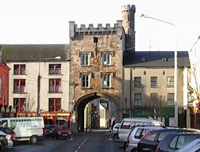
|
| 1837 |
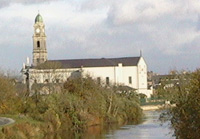
St. Mary's Church, Irishtown. The original St. Mary's Catholic church was a thatched building. The present church was completed c. 1856. The tower was erected c. 1880. |
|
| 1920 |
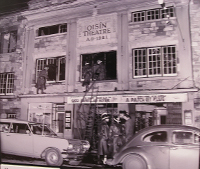
Oisin Theatre/Cinema Is was a stylish theatre, with a 'pit', 'balcony', 'gods', etc., and with dark drapes on all exits/entrances, brass rails everywhere, to provide a handhold when going up or descending the steep steps of the balcony. A fire engulfed the building in 1965, and it was never rebuilt. Heatons Dept. store now occupies the site, in O'Connell St. The fial evening film shown was "A Patch of Blue", starring Sidney Poitier and Shelley Winters.
|
|
Year |
Building of Note |
Picture |
| 1842 | Mulcahy House. Was the Mechanics Institute, 1842, later the Central Technical Institute ('The Tech'). | 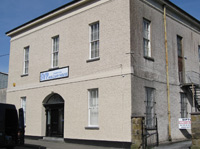
|
| 1833 | St Luke's Hospital | |
|
1843 |
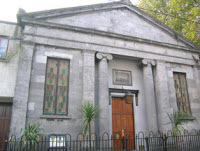
White Memorial Theatre.Originally a Wesleyan Methodist chapel, it was built by William Tinsley, at a cost of £600. This building/chapel became the replacement for the earlier Wesleyan chapel, which was situated approximately where the Parochial Hall on the grounds of Old St. Mary's now stands. |
|
|
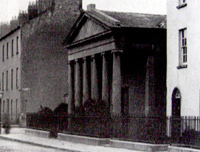
1838 |
Scots Church This was built by Protestant dissenters - Unitarians who had previously occupied part of the Franciscan Friary. Opened in 1838, it finally ceased to be used as a chapel in 1970. Later on it was at times, a car salesroom and an antiques shop. |
|
| 18xx | TSB - site of Clonmel Arms Hotel. Charles Riall established a bank here. It lasted only a short while. The Provincial Bank then opened in the same premises in 1825 | 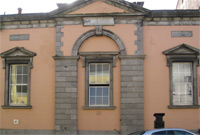
|
| 1848 | Model School | 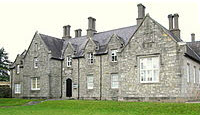
|
| 1852 | Railway Station.Thurles line opened 1880. | 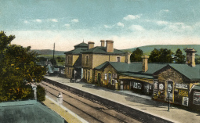
|
| 1835 |
Bank of Ireland building. (Parnell St). Opened in 1835, as the National Bank - the name is cut in stone high up on the building. It became part of the Bank of Ireland Group in the 1960's, when various banks merged to become either the Bank of Ireland or Allied Irish Banks. |
|
| 1881 |
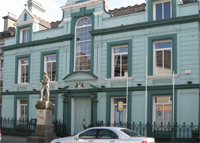
Town Hall. It was originally a private mansion owned by Richard Hamerton, and known as Hamerton Hall. In the 18th century, the building was converted into an inn - the Great Globe Inn. In 1881, it was entirely rebuilt as the Town Hall. To the front of the building is a commemorative statue to the Men of '98. |
|
| 1886 | Railway Station Footbridge. | 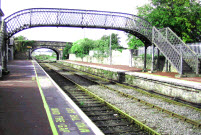
|
| 1888 |
St. Patrick's Cemetery. Opened in 1886, during the mayoralty of Jeremiah Wright, a shopkeeper from Main St. It became the town cemetery, catering for all religions, and none. |
|
| 1853 |
St. Joseph's Hospital Originally served as a Workhouse, it later became St. Josephs Hospital, now renamed South Tipperary General Hospital. |
|
| 1905 |
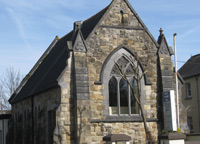
Methodist Church, Anglesea St. Served as a church up to the 1970's, after which it became a trade union headquarters. |
|
| 1940's |
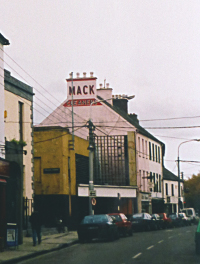
The Ritz Cinema Built on the site of a bakery, The Ritz Cinema was opened in the 1940's, its frontage built in an Art Deco style. As cinemagoing became less popular throughout the 1970's, and into the 80's, it finally closed its doors in the 80's and lay derelict for many years. The Clonmel Credit Union eventually purchased the site, demolished the old building,and a new building on the site is now its headquarters. Pic shows it not long before it was demolished. |
|
| 1915 |
Regal Theatre Has seen many changes of use. Originally a theatre, it burned down in 1919, was rebuilt,then reopened around 1921. It was tranformed into a cinema during the 1970's, which closed in 2001. It later became a theatre once again, and finally served as a furniture showrooms. |