Clonmel Workhouse
Clonmel Poor Law Union
1839-1924
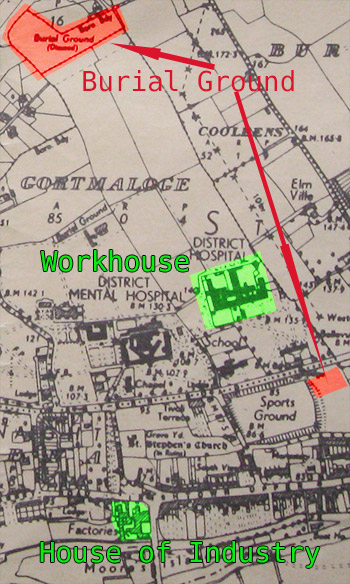
was officially formed in March 1839, and was responsible for the running of theClonmel Workhouses. The first Workhouse was located in an already existing "House of Industry", located at the junction of Upper Irishtown and Convent Road - where "Chappies" dog-food factory once stood. This House of Industry was opened in1811, and served as a place to temporarily house both 'vagrants' and 'lunatics'.
By the late 1840's, it was overcrowded, presumably due to the effects of the Great Famine, and so, in 1853 a new Workhouse was opened. This was situated on the site and in the building presently used by Tipp South General Hospital.
It continued to be used until 1924, when, under the new Free State government, it was shut down. Financing for the Poor Law Union was via the 'rates' collected from property owners, under the act, and known as the Poor Law Valuation, which was applied to properties which were rated by local authorities, i.e. a property tax.
For more, see the excellent websites:
http://www.workhouses.org.uk/Clonmel/
irishworkhousecentre.ie
Houses of Industry
‘Houses of Industry’, the earlier name for workhouse-type institutions, existed in Ireland prior to the Union of Great Britain and Ireland in 1800, but it was the Irish Poor Law Act of 1838 that brought the workhouse system to Ireland, creating an initial 130 unions, a figure that rose to 163. All Irish workhouses were built to the English model, were designed by architect George Wilkinson, and 112 had been completed by April 1843.
Life in Irish workhouses was even harsher than in their English counterparts with cramped, poorly ventilated dormitories, raised planks and straw mattresses for beds, and toilet facilities that were far from adequate for the numbers housed. Irish workhouses came under immense pressure during the Great Famine of 1845–50 as the system struggled to cope with the demand for space.
Conditions within the workhouse worsened during the period as diseases such as typhus fever and dysentery struck many inmates and many workhouse burial grounds overflowed.
Burial Grounds
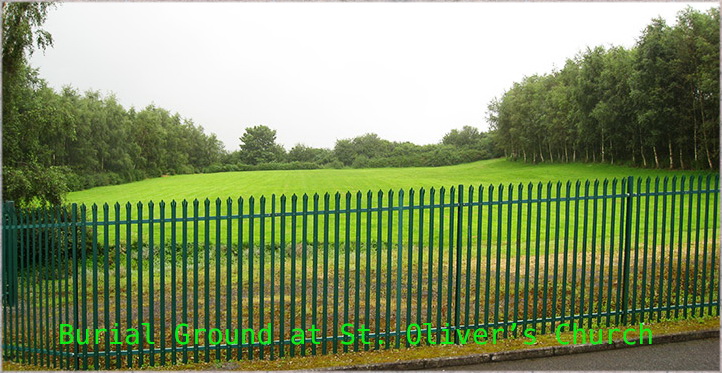
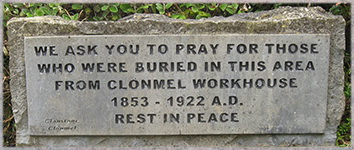
Burials of those who died while resident in the workhouse, before 1886 (when the new St. Patrick's Cemetery was opened) took place mainly at 2 locations, as seen on the map above. The smaller was situated at the entrance to the ALDI supermarket on the Western Road, in the fenced-off area. The second burial ground is situated in front of St. Oliver's church, in Elm Park, again in a fenced-off area, see image below. There are around 125 recorded graves of those who died in the Workhouse/Clonmel Union, who are buried at St. Patrick's Cemetery.
At St. Oliver's Church